

Your Filipino last name holds centuries of history, faith, and cultural survival. It isn’t just a label on your birth certificate. It’s a living connection to ancestors, colonial struggles, and indigenous wisdom passed down through generations.
Whether you’re tracing your genealogy, writing a story, or simply curious about your heritage, understanding Filipino surnames opens a fascinating window into Philippine history. This guide covers 500+ Filipino last names,from the most common Filipino surnames to rare indigenous names that survived centuries of colonial pressure.
The History of Filipino Surnames
Filipino family names didn’t always exist in the form we know today. Before Spanish colonization in 1521, Filipinos used single names rooted in nature, character traits, and ancestral connections. Names like Bayani (hero) and Tala (star) weren’t just identifiers,they were spiritual statements.
Spanish rule fundamentally changed this. Over 333 years of colonization, the Catholic Church assigned baptismal names during conversion. Filipino clan names and origins became tangled with Spanish identity. Then came the defining moment in Philippine naming history: the 1849 Clavería decree.
Today, Filipino genealogy surname research reveals three layers of naming history,pre-colonial indigenous names, colonial-era Spanish surnames, and modern adaptations. Understanding all three is the only way to fully grasp what your family name truly means.
Spanish Influence on Filipino Last Names
Walk through any Philippine census record and one pattern stands out immediately. The overwhelming majority of Filipino surnames sound unmistakably Spanish,Garcia, Torres, Reyes, Santos. This isn’t a coincidence. It’s the direct result of 333 years of Spanish colonization of the Philippines.
Spanish influenced Filipino surnames came from several sources. Catholic baptisms assigned saints’ names. Spanish administrators used Hispanic surnames Philippines to organize populations. Intermarriage with Spanish settlers created mestizo lineages carrying names like Villanueva and Fernandez.
Many popular Filipino surnames list entries are actually occupational Spanish words,Guerrero means warrior, Herrera means iron worker, Castillo means castle. Others describe geography. Mendoza traces to a cold mountain region in Spain. Navarro references the Spanish kingdom of Navarre.
The irony? Most Filipino families have no Spanish blood at all. Their Spanish Filipino surnames were assigned by colonial administrators, not inherited through ancestry. This makes traditional Filipino surnames among the most politically layered family names anywhere in Southeast Asian surnames history.
The 1849 Clavería Decree and Its Impact
No single event shaped Filipino family names more than the Clavería decree 1849. Governor-General Narciso Clavería issued this colonial era surnames mandate with one goal: administrative efficiency.
Before 1849, record-keeping across the Philippines was chaotic. Many families in different provinces shared identical names, making taxation, military conscription, and census tracking nearly impossible. Clavería’s solution was systematic and sweeping.
He distributed an alphabetized catalogue of over 61,000 Spanish surnames,plants, animals, geography, virtues,to provincial governors. Different provinces received different sections of the alphabet. This is why today you can roughly trace Philippine ancestry research by surname,families named Abueva likely trace to provinces receiving early-alphabet surnames, while Zulueta families come from regions assigned Z-section names.
The historical Filipino surnames created under this naming law reshaped Filipino cultural identity permanently. Families lost indigenous Filipino surnames overnight. Yet many quietly preserved native Tagalog surnames as nicknames or middle names, keeping their ancestral identity alive beneath Spanish colonial labels.
Pre-Colonial Filipino Naming Traditions
Before the Spaniards arrived, Filipino naming traditions were poetic and purposeful. Indigenous Filipino last names reflected the natural world, spiritual beliefs, and community values of Philippine tribes. There were no fixed hereditary surnames,names shifted with life events, achievements, or spiritual experiences.
Native Filipino names drew heavily from nature. Bagwis meant wing. Tala meant star. Lakas meant strength. These weren’t random choices. Filipino tribal names connected individuals to the cosmos, to ancestral spirits called anito, and to the communal identity of their barangay.
Spiritual leaders called babaylan held enormous naming authority. They assigned names during ceremonies that blended indigenous beliefs with observations about a child’s destiny. This oral tradition carried no alphabetical list of Filipino surnames,instead, naming was a living, breathing cultural act performed by communities rather than governments.
When Spanish missionaries recorded these names, they often simplified or replaced them entirely. Yet traces of old Filipino family names survived in remote provinces, passed down through oral history, folk literature, and the determined memory of communities who refused complete cultural erasure.
Most Common Filipino Last Names
The most common Filipino last names today reflect Catholic devotion, Spanish administrative history, and the lasting reach of the Clavería decree. Here are the most frequently appearing names across Philippine census records and diaspora communities:
- Santos,Saints; one of the most recognized common Filipino surnames nationwide
- Reyes,Kings; carries noble heritage symbolism
- Cruz,Cross; deeply tied to Catholic Filipino identity
- Bautista,Baptist; references John the Baptist
- Garcia,Bear; Spanish origin with strength symbolism
- Mendoza,Cold mountain; Basque-Spanish geographic name
- Torres,Towers; architectural reference from colonial Spain
- Fernandez,Son of Fernando; classic patronymic tradition
- Lopez,Wolf; Spanish animal symbolism
- Gonzalez,Son of Gonzalo; family lineage name
- Dela Cruz,Of the cross; common Filipino surname with deep Catholic roots
- Ramos,Branches; references the family tree
- Villanueva,New town; geographic origin name
- Castillo,Castle; occupational/architectural heritage
- Morales,Blackberry place; geographic Spanish origin
These popular Filipino surnames appear on millions of birth certificates across Luzon, Visayas, and Mindanao, as well as in Filipino diaspora communities across the United States, Canada, and the Middle East.
Popular Filipino Surnames and Their Meanings
Beyond the top ten, hundreds of Filipino surnames and their meanings tell fascinating stories of migration, faith, and cultural identity. Here’s a curated alphabetical list of Filipino surnames with clear meanings:
- Aguilar,Eagle place; Spanish geographic name
- Aquino,From Aquino, Italy; famous through Benigno Aquino
- Caballero,Knight or horseman; Spanish noble heritage
- Espiritu,Holy Spirit; deeply spiritual Catholic Filipino last name
- Hidalgo,Nobleman; Spanish aristocratic lineage
- Jimenez,Son of Jimeno; classic Spanish patronymic
- Luna,Moon; nature-inspired surname with poetic resonance
- Navarro,From Navarre, Spain; historical kingdom reference
- Ortega,Nettle place; Spanish geographic surname
- Perez,Son of Pedro; widespread patronymic name
- Ramirez,Son of Ramiro; Spanish lineage name
- Rivera,Riverbank; nature-inspired geographic name
- Sanchez,Son of Sancho; patronymic tradition
- Valdez,Son of Baldo; Spanish ancestral name
- Vargas,Steep place; Spanish topographic surname
This Filipino genealogy surname list barely scratches the surface. Each name carries its own migration story, connecting families to specific Spanish regions, religious figures, or geographic features.
Traditional Indigenous Filipino Last Names
Not every Filipino family name came from Spain. Traditional Filipino surnames rooted in indigenous language survived,especially in regions where Spanish administration reached less deeply. These old Filipino family names carry Tagalog, Ilocano, and Visayan roots that connect bearers to pre-colonial Philippine culture.
Tagalog surnames with deep cultural meaning:
- Liwanag,Light, spiritual illumination
- Dalisay,Pure, untainted
- Halili,Successor, one who continues legacy
- Silang,Birth, new beginnings
- Bagwis,Wing, freedom
- Tala,Star, celestial guide
- Lakas,Strength, inner power
- Pag-asa,Hope, optimism
- Bayani,Hero, courageous protector
- Malaya,Free, independent
Ilocano surnames with ancestral power:
- Agbayani,To be heroic
- Baquiran,Forest dweller
- Dacanay,From the river
- Galang,Respect and honor
- Lacson,From the lake
These indigenous Filipino surnames aren’t museum pieces. Thousands of Filipino families still carry these names today, and the Filipino naming traditions behind them are experiencing genuine cultural revival in 2026.
Rare Filipino Last Names
Some Filipino family names are so uncommon that encountering one feels like archaeological discovery. Rare Filipino last names often survived because of geographic isolation, family determination, or simple administrative oversight during the Clavería cataloguing process.
Rare indigenous names worth knowing:
- Liwayway,Dawn, early morning light
- Tanglaw,Beacon of hope, lamp
- Kariktan,Beauty, elegance
- Ningning,Brightness, shine
- Sinag,Ray of light
- Kisapmata,Twinkling of an eye
- Bagani,Warrior, fighter
- Maharlikang,Noble, aristocratic
- Maginoo,Nobleman, aristocrat
- Bathala,Supreme deity in pre-colonial belief
Rare Filipino surnames often carry the most emotionally resonant meanings. Families bearing names like Dalisay or Ginhawa carry linguistic gems that preserve ancient Filipino beauty in ways that common Spanish-origin surnames simply cannot match.
These unique Filipino family names are also gaining popularity in 2026 as diaspora communities seek stronger connections to Philippine cultural identity beyond colonial-era labels.
Unique Filipino Last Names for Inspiration
Writers, parents, and genealogy enthusiasts often seek unique Filipino last names that stand apart from the crowd. Here are distinctive surnames that blend history with cultural depth:
- Marangal,Honorable, dignified
- Magiting,Brave, valiant
- Bantog,Famous, renowned
- Matatag,Firm, steadfast
- Ligaya,Joy, celebration
- Dakila,Great, magnificent
- Ginhawa,Comfort, ease
- Pangarap,Dream, aspiration
- Tagumpay,Victory, triumph
- Kapayapaan,Peace, harmony
- Masaya,Happy, joyful
- Maligaya,Blessed, fortunate
- Mayumi,Tender, gentle
- Makisig,Handsome, appealing
- Marilag,Beautiful, radiant
These unique Filipino last names for inspiration work equally well for fictional characters, pen names, or families reclaiming pre-colonial identity. Each one carries a meaning worth building an entire personal story around.
Filipino Last Names Based on Nature
Nature-inspired surnames appear across every era of Philippine naming history,pre-colonial, colonial, and modern. The Philippine archipelago’s extraordinary biodiversity gave communities endless naming material, from volcanic mountains to tropical seas.
Filipino last names rooted in nature:
- Flores,Flowers; Spanish-origin nature name
- Rio,River; flowing water symbolism
- Monte,Mountain; strength and permanence
- Valle,Valley; peace and shelter
- Campo,Field; abundance and harvest
- Piedra,Stone; permanence and foundation
- Ramos,Branches; family tree symbolism
- Luna,Moon; feminine energy and cycles
- Sol,Sun; life force
- Estrella,Star; celestial guidance
- Araw,Sun in Tagalog; brightness
- Buwan,Moon in Tagalog; natural cycles
- Hangin,Wind; movement and change
- Tubig,Water; life source
- Lupa,Earth; grounding and roots
Nature-based Filipino surnames reflect how deeply Filipinos connected personal identity to the natural world. Whether Spanish or Tagalog in origin, these names share one common thread,they ground the bearer in something larger than themselves.
Filipino Surnames With Religious Meanings
Catholic Filipino last names form one of the largest surname categories in the Philippines. Spanish missionaries assigned religious surnames during baptism, creating an entire layer of Catholic Filipino last names tied to saints, sacraments, and sacred concepts.
Catholic-inspired Filipino surnames:
- Santos,Saints, holy ones
- Cruz,Cross, sacrifice and redemption
- Bautista,John the Baptist
- Espiritu,Holy Spirit
- Bendicion,Blessing, divine favor
- Milagro,Miracle, divine intervention
- Angel,Messenger of God
- Rosario,Rosary, prayer and devotion
- Trinidad,Holy Trinity
- Gracia,Grace, divine mercy
- Salvador,Savior, redemption
- Del Rosario,Of the Rosary
- San Jose,Saint Joseph
- Dela Cruz,Of the Cross
Indigenous spiritual surnames that survived colonization:
- Diwata,Nature spirit, fairy goddess
- Babaylan,Shaman, spiritual healer
- Anito,Ancestor spirit
- Likha,Creation, divine artistry
- Kaluluwa,Soul, spiritual essence
Filipino surnames and religious meaning tell the story of a nation caught between indigenous animistic beliefs and imposed Catholic faith,and the remarkable way Filipinos blended both into a unique spiritual identity.
Filipino Last Names Derived From Occupations
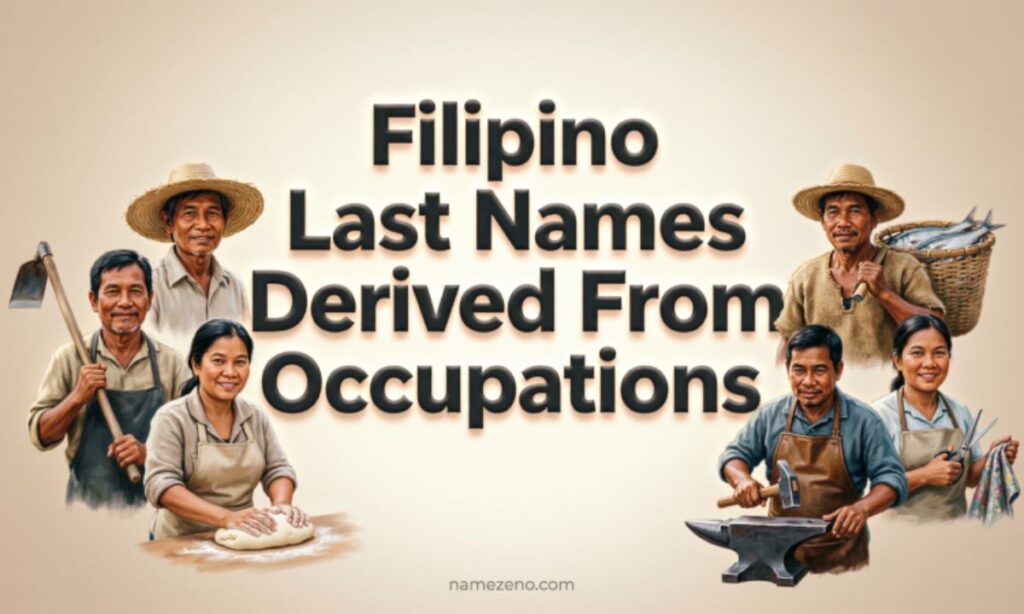
Occupational surnames appear across multiple cultural layers in Filipino genealogy. Spanish administrators assigned these names based on trades, military ranks, and social roles. Some indigenous occupational names survived the colonial transition as well.
Occupation-based Filipino surnames:
- Guerrero,Warrior, soldier
- Herrera,Iron worker, blacksmith
- Caballero,Knight, horseman
- Pescador,Fisherman
- Labrador,Farmer, cultivator
- Carpintero,Carpenter
- Tejero,Tile maker
- Pastor,Shepherd
- Maestro,Teacher, master
- Escribano,Scribe, writer
- Albularyo,Traditional healer
- Babaylan,Shaman, spiritual healer
- Manghihilot,Massage healer
- Katalonan,Priestess, oracle
These historical Filipino surnames reveal the professional landscape of colonial Philippines. Families carrying names like Herrera or Carpintero likely trace their lineage to skilled craftsmen who received their surnames as direct occupational labels during Spanish administrative registration.
Regional Filipino Surnames (Luzon, Visayas, Mindanao)
The Philippines isn’t culturally uniform, and neither are its surnames. Filipino last names by region reflect the distinct linguistic traditions, Spanish administrative patterns, and indigenous heritage of Luzon, Visayas, and Mindanao.
Luzon (Ilocano and Tagalog Region):
- Agbayani,To be heroic (Ilocano)
- Baquiran,Forest dweller (Ilocano)
- Dacanay,From the river (Ilocano)
- Galang,Respect, honor (Tagalog)
- Lacson,From the lake (Tagalog)
- Manalo,To win, victor (Tagalog)
- Panganiban,Protector, guardian (Tagalog)
- Marasigan,Aristocratic family (Tagalog)
- Pangilinan,From the shelter (Tagalog)
Visayas Region:
- Bacalod,Stonehill
- Iloilo,From the nose-like geographic shape
- Cebuano,From Cebu island
- Negros,Black island reference
- Leyte,Island heritage name
Mindanao Region:
- Davao,Fire, flame
- Maranao,People of the lake
- Tausug,Current of the sea
- Maguindanao,People of the flood plains
- Lumad,Indigenous Mindanao heritage
Regional Filipino surnames act as geographic DNA. Genealogy researchers studying Philippine ancestry research often use regional clustering patterns to trace family migration routes across the archipelago over centuries.
How Filipino Last Names Are Structured
Understanding Filipino surname structure helps with both genealogy research and cultural literacy. Filipino naming conventions follow a hybrid system shaped by Spanish patronymic tradition and indigenous practices.
Children traditionally inherit their father’s surname. Women historically kept their maiden names professionally even after marriage,a practice that created the dual-surname patterns common in Filipino-American family names in the US.
The naming format in the Philippines typically follows: First Name + Middle Name (mother’s maiden name) + Surname. This middle name convention preserves maternal lineage in a way most Western naming systems don’t, giving Filipino genealogy researchers a built-in family tree tool in every full legal name.
Chinese-Filipino families,the mestizo community,often carry hyphenated surnames blending Chinese and Spanish elements. Names like Cojuangco, Yuchengco, and Gokongwei reflect this merchant class heritage. The Chinese community’s migration to the Philippines created a third naming layer that’s often overlooked in standard Filipino last names discussions.
Nicknames hold particular power in Filipino culture. “Jun” for Junior, “Bong” as a common nickname, “Ate” for older sister,these informal names often stick more permanently than legal surnames in daily life.
How to Choose a Filipino Last Name for Characters or Stories
Filipino last names for characters require matching the surname’s meaning to the character’s personality, backstory, or story arc. A Filipino genealogy names approach works best,ask what story you want the name to tell before choosing it.
For hero or warrior characters:
- Guerrero,Warrior
- Valiente,Brave
- Magiting,Valiant
- Bagani,Fighter
- Matapang,Courageous
For elegant or romantic characters:
- Kariktan,Beauty
- Liwanag,Light
- Marilag,Radiant
- Dulce,Sweet
- Encanto,Charm
For mysterious or complex characters:
- Sombra,Shadow
- Misterio,Mystery
- Oscuro,Dark
- Profundo,Deep
- Enigma,Puzzle
For traditional family-centered characters:
- Halili,Successor
- Legado,Legacy
- Ancestro,Ancestor
- Generacion,Generation
- Herencia,Heritage
The best Filipino surnames for storytelling carry double meaning,one surface meaning and one deeper cultural resonance that rewards readers who research further. Names like Bayani (hero) or Malaya (free) communicate character purpose without a single line of dialogue.
Frequently Asked Questions
What are the most common Filipino last names today?
Santos, Reyes, Cruz, Bautista, and Garcia rank among the most common Filipino surnames across the Philippines and diaspora communities globally.
Why do Filipino last names sound Spanish?
The 1849 Clavería decree mandated Spanish surnames for all Filipinos during colonial rule. This single decree is why Hispanic surnames Philippines dominate modern naming patterns.
What are some rare Filipino last names with indigenous origins?
Rare indigenous Filipino surnames include Liwayway (dawn), Bagwis (wing), Dalisay (pure), Bathala (supreme deity), and Bagani (warrior),names that survived colonial-era replacement through geographic isolation or family preservation.
How did the Clavería decree affect Filipino cultural identity?
The Clavería decree 1849 replaced most indigenous Filipino surnames with alphabetized Spanish names distributed by province. It severed many families from their pre-colonial naming traditions while creating the regional surname clustering patterns used in Philippine ancestry research today.
Can Filipinos legally change back to indigenous surnames?
Yes. Philippine law allows legal name changes, and a growing movement within the Filipino diaspora actively reclaims pre-colonial Filipino names as part of broader decolonization efforts in 2026.
What is the difference between Tagalog, Ilocano, and Visayan surnames?
Each region developed distinct indigenous naming traditions. Tagalog surnames focus on virtue and nature, Ilocano surnames often reference geographic features and heroic qualities, while Visayan surnames reflect the unique cultural and geographic identity of the island groups in the central Philippines.
Conclusion
Filipino last names are living archives of a nation’s most complicated centuries. Every surname,whether Spanish in sound or Tagalog in soul, carries the weight of colonial history, indigenous resilience, Catholic faith, and family pride compressed into a few syllables.
Your Filipino surname connects you to ancestors who survived cultural erasure, adapted under pressure, and still managed to preserve meaning within mandated names. Whether your family name means “warrior,” “light,” “king,” or “cross,” it belongs to a larger story stretching back before 1849, before 1521, to a time when Filipinos named themselves by the stars, the rivers, and the strength they carried inside.

Jack is a niche writer specializing in creative pet names and wildlife-inspired naming guides. He creates well-researched, easy-to-read content that helps readers discover meaningful and memorable names for their animals.